Genetic Modification And Cloning / Genetic Engineering Selective Breeding Worksheets Teaching Resources Tpt / An organism that receives the recombinant dna is called a genetically modified organism (gmo).
Genetic Modification And Cloning / Genetic Engineering Selective Breeding Worksheets Teaching Resources Tpt / An organism that receives the recombinant dna is called a genetically modified organism (gmo).. Genetic modification and cloning genetic modification transplants genes for a desired characteristic into a different organism. Clones are groups of genetically identical organisms, derived from a single original parent cell. However, increasing costs meant that its production had to be halted. Learn more about cloning at our cloning faqs page. Genetic modification and cloning are two main prominent yet ethical implications.
Many plant species and some animal species have natural methods of cloning. Genetic modification is not the same as cloning. Through the process of asexual reproduction, organisms such as bacteria (and some plants) create offspring that are genetically identical to the parent. Using our current technologies, we would implement enzymes from bacteria to locate genes with in our dna to create the necessary modifications for duplication. Cloning makes an identical genetic copy of a parent plant or animal.
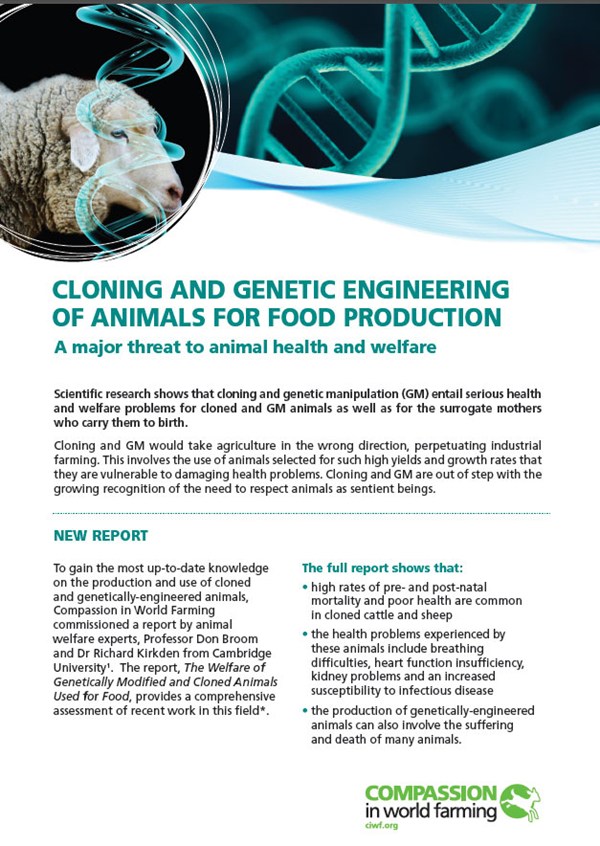
Cloning And Genetic Engineering Of Animals For Food Production Compassion In World Farming from www.ciwf.org.uk Clones are the mature organisms created by replicating abiotically most or all of the dna of the organisms. Many plant species and some animal species have natural methods of cloning. Cloning was explained as a way of science where the act of copying an organism with the exact traits, appearance and behavior using genetics. Research cloning, also known as embryo cloning or therapeutic cloning, is another form of human cloning that produces genetically specific embryonic stem cells. Genetic modification and cloning are two main prominent yet ethical implications. Human genetic modification, human reproductive cloning, and embryonic stem cell research and research cloning. Addition of foreign dna in the form of recombinant dna vectors that are generated by molecular cloning is the most common method of genetic engineering. Cloning makes an identical genetic copy of a parent plant or animal.
Genetically modified organisms (gmos) are seeds, plants, rootstocks, animals, or microorganisms created by inserting foreign genes to impart a desired trait.
Genetic modification, like any technology, should be seen as what has gone earlier. Animals can be cloned at the embryo stage by breaking up the embryo into more than one group of cells. The use of cloned and genetically modified organisms, or gmos, remains controversial among scientists, activists and consumers. Cloned animals are different from genetically modified (gm) animals, even though they are all results from the tools of biotechnology. Therapeutic cloning and genome modification the rapid advances over the past few decades in biotechnologies involving somatic cells and gene therapy offer a great potential in regenerative medicine. Genetic modification and cloning genetic modification transplants genes for a desired characteristic into a different organism. Genetic modification genetic modification (gm, also called genetic engineering) involves taking a gene from one species and putting it into. The procedure consists of inserting a gene from one organism, often referred to as foreign dna, into the genetic material of a carrier called a vector. An organism that receives the recombinant dna is called a genetically modified organism (gmo). Human cloning unlocks the benefits of genetic modification. Therapeutic cloning has the potential to. Researchers routinely use cloning techniques to make copies of genes that they wish to study. Clones are groups of genetically identical organisms, derived from a single original parent cell.
Genetic modification and cloning genetic modification transplants genes for a desired characteristic into a different organism. Cloned animals are different from genetically modified (gm) animals, even though they are all results from the tools of biotechnology. If the foreign dna that is introduced comes from a different species, the host organism is called. Human cloning requires a precise form of genetic engineering. A clone is a genetically identical copy of an organism, and it may be naturally occurring or created in the lab.
Genetic Engineering And Cloning Ppt Download from slideplayer.com Learn more about cloning at our cloning faqs page. Genetic modification is not the same as cloning. Cloning can be done using somatic cell nuclear transfer. It allows for growing eminent individuals. Clones are the mature organisms created by replicating abiotically most or all of the dna of the organisms. • flavsavr tomatoes were the world's first genetically modified food. Genetic modification and cloning genetic modification transplants genes for a desired characteristic into a different organism. Considering the huge number of people on organ donation waiting lists, this is extremely beneficial.
Clones are groups of genetically identical organisms, derived from a single original parent cell.
Therapeutic cloning and genome modification the rapid advances over the past few decades in biotechnologies involving somatic cells and gene therapy offer a great potential in regenerative medicine. Clones are groups of genetically identical organisms, derived from a single original parent cell. Clones are the mature organisms created by replicating abiotically most or all of the dna of the organisms. Genetic cloning allows scientists to take small amounts of cells from a certain organ and use them to generate and harvest new organs that are entirely functioning. Learn more about cloning at our cloning faqs page. However, increasing costs meant that its production had to be halted. Research cloning, also known as embryo cloning or therapeutic cloning, is another form of human cloning that produces genetically specific embryonic stem cells. Genetic modification, like any technology, should be seen as what has gone earlier. Animals can be cloned at the embryo stage by breaking up the embryo into more than one group of cells. Cloning makes an identical genetic copy of a parent plant or animal. Human cloning unlocks the benefits of genetic modification. Genetic modification genetic modification (gm, also called genetic engineering) involves taking a gene from one species and putting it into. Genetic modification and cloning genetic modification transplants genes for a desired characteristic into a different organism.
• flavsavr tomatoes were the world's first genetically modified food. A clone is a genetically identical copy of an organism, and it may be naturally occurring or created in the lab. Cloned animals are different from genetically modified (gm) animals, even though they are all results from the tools of biotechnology. Cloning makes an identical genetic copy of a parent plant or animal. Through the process of asexual reproduction, organisms such as bacteria (and some plants) create offspring that are genetically identical to the parent.
Genetically Modified Organisms Gene Expression Mutation And Cloning Ppt Video Online Download from slideplayer.com Learn more about cloning at our cloning faqs page. Cloning makes an identical genetic copy of a parent plant or animal. The genetic modifications could be aimed at giving such children genetic characteristics of both members of the couple concerned. An organism that receives the recombinant dna is called a genetically modified organism (gmo). Genetic modification and cloning genetic modification transplants genes for a desired characteristic into a different organism. Genetic modification is not the same as cloning. Some fish species plants retain pluripotent cells (called meristem) and can reproduce asexually via vegetative propagation hence new plant clones can be grown from stem cuttings Cloned animals are different from genetically modified (gm) animals, even though they are all results from the tools of biotechnology.
Cloning creates an exact copy of all or part of an organism's dna, while genetic modification makes changes to existing dna to create a new, modified version of the genome.
Cloning makes an identical genetic copy of a parent plant or animal. Clones are groups of genetically identical organisms, derived from a single original parent cell. It allows for growing eminent individuals. However, increasing costs meant that its production had to be halted. Genetic modification and cloning genetic modification transplants genes for a desired characteristic into a different organism. Human genetic modification, human reproductive cloning, and embryonic stem cell research and research cloning. Genetic modification and cloning genetic modification transplants genes for a desired characteristic into a different organism. The use of cloned and genetically modified organisms, or gmos, remains controversial among scientists, activists and consumers. • flavsavr tomatoes were the world's first genetically modified food. Genetic modification is carried out by gene transfer between species. Research cloning, also known as embryo cloning or therapeutic cloning, is another form of human cloning that produces genetically specific embryonic stem cells. Addition of foreign dna in the form of recombinant dna vectors that are generated by molecular cloning is the most common method of genetic engineering. There is no right to have a genetically related child.